
Yogi Milarepa

One day, while I was scrolling through Instagram, I came across a post about the story of a Tibetan man named Yogi Milarepa(opens a new tab)
He is believed to have been born in Tibet around 1052 and to have died around 1135. He was a Tibetan yogi, poet, and spiritual teacher. After a youth marked by family conflicts and great hardships, he turned to Buddhism.
He became a disciple of Marpa, under whom he underwent very demanding training, before meditating for years in caves and remote places. He is considered one of the great saints and yogis of Tibetan Buddhism.

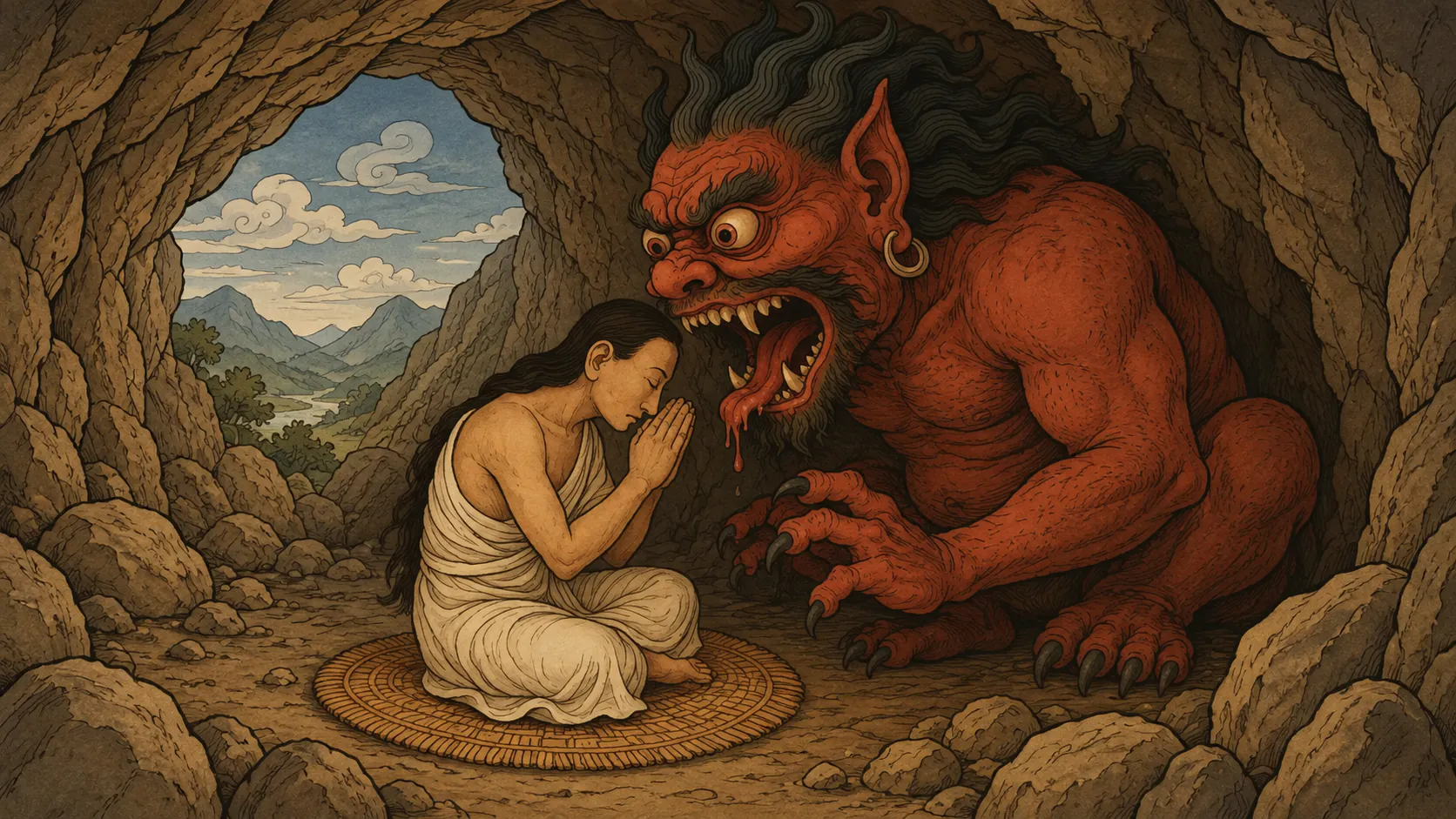
One day, Milarepa returns to his cave after going out to gather firewood. When he enters, he discovers that it is filled with demons. They are everywhere, settled in his meditation space as if they were at home.
His first reaction is anger. He immediately wants them gone and starts chasing them. The more he gets angry, struggles against them, and tries to drive them out, the more powerful the demons seem to become. They do not retreat; on the contrary, they appear even more present and harder to dislodge.
Milarepa then tries other methods. In some versions of the story, he recites formulas to make them disappear. But nothing changes. The demons remain, as if they were feeding on all the energy he spends fighting them.
He then decides to speak to them and teach them Buddhism. He explains compassion, kindness, impermanence, and the nature of existence. But even this approach fails: the demons listen without moving, and none of them leaves the cave.
Milarepa then understands that he is still trying to make them leave. Even his wisest words conceal a desire to control the situation. So he stops fighting and accepts the possibility that the demons may stay.
He looks at them one by one, bows to them, and opens himself to what they may have to teach him. From that moment on, almost all the demons disappear. Only one remains, the largest and most terrifying.
Milarepa then gives up all resistance. He approaches the demon and offers it his entire body, as if saying: “If you want to devour me, go ahead.” He places his head inside its mouth.
The demon then bows and dissolves into space. Milarepa did not defeat it by being more violent or more powerful. He stopped feeding it the fear, anger, and resistance that seemed to make it stronger and stronger.
This story can be understood as an image of our fears, our wounds, and the parts of ourselves we refuse to look at. The angrier we become with them and the more we try to push them away, the more space they can take up.
By accepting to observe them with clarity, gentleness, and compassion, we can begin to understand what they are trying to show us. What terrifies us gradually loses its power, not because we destroyed it, but because we stopped feeding it.
I admit that I asked ChatGPT to write this part based on several sources, and I find the result quite satisfying.

I find this story really interesting because, to me, it explains how we should act when the people behind the phenomenon interact with us.
We need to play along, not fight, and accept that they are trying to help us. Their behavior is a little like that of a magnifying mirror, or of caricaturists reflecting our emotions and the image we have of them. So if we see them as horrible people, they play along. But if we see them for what they really are, good and upright people, then everything goes as well as possible.
Why do we call them demons if they are here to help us? That is what I explain in the most important lesson they have taught me. We should not be afraid to question everything, especially when it concerns the phenomenon (religion, conspiracy theories, and psychiatry).
What is interesting about this story is that it took place around 900 years ago, and in Tibet on top of that. At the time, there was no CIA or DARPA, no American government, no artificial intelligence, no deep state, no secret technologies, no psychiatrists, and so on.
And yet Yogi Milarepa experienced what many people today would call « gangstalking » or « schizophrenia ».
And he came through it well! So what did he do to make things better? From another person's point of view? Nothing. NOTHING. And from his point of view? He simply accepted the existence of the phenomenon deep within himself and accepted that they were not bad, but good and upright, and that they were trying to help him.
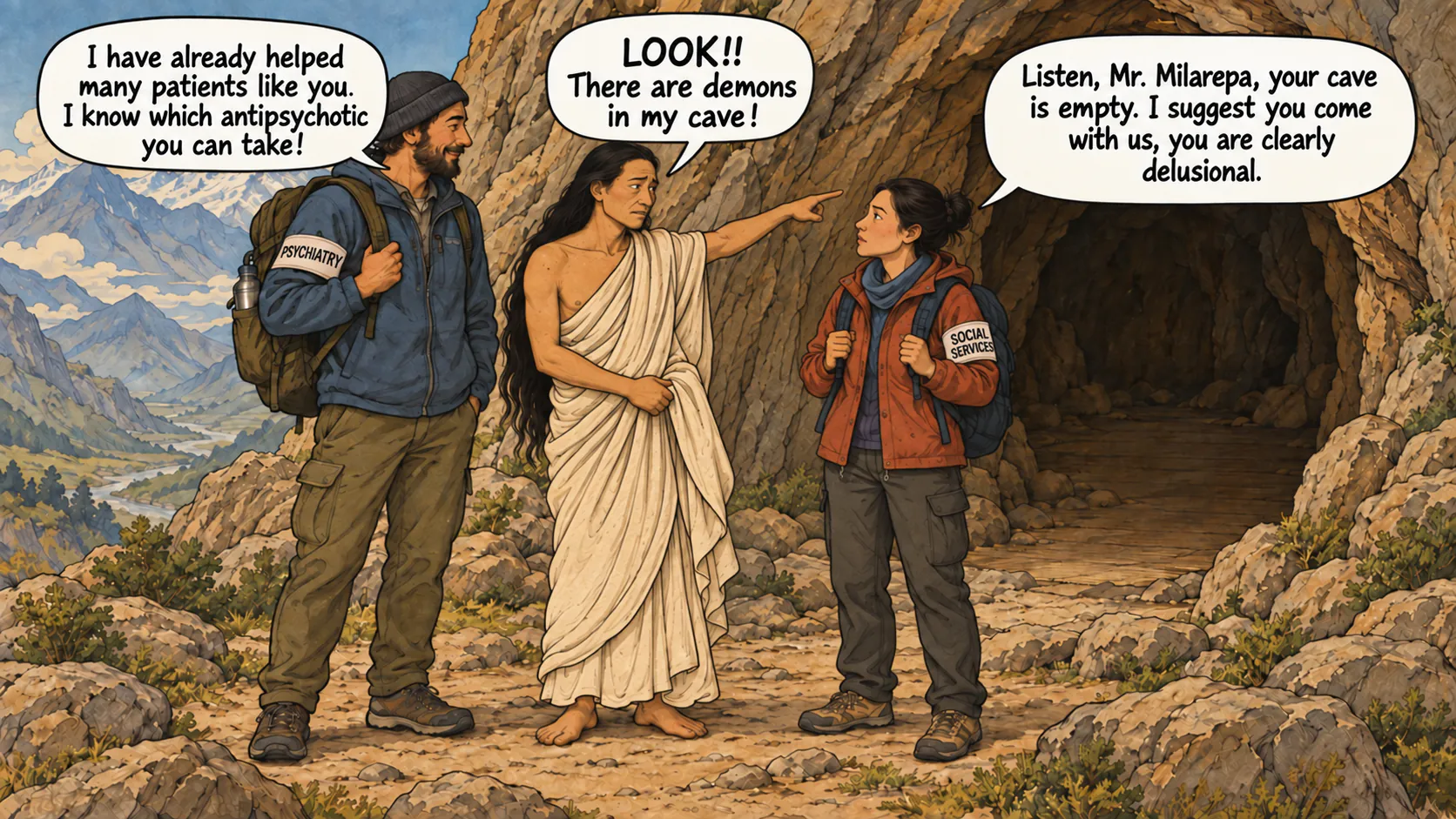
Sometimes I do slightly strange thought experiments, and I think: imagine if social services or psychiatrists had already existed back then and had come to meet Yogi Milarepa to offer him « help »
They would probably have arrived at his cave and seen that there was absolutely nothing inside except the remains of a guy who had let himself go a little too far. And then? They might have realized that they were clearly dealing with a serious case: someone in a terrible situation and very probably « schizophrenic ». So they would have taken him away to get help and receive treatment, with or without Mr. Milarepa's consent. And that is understandable, because with people like that, you never know what might happen.

After that, everything would have gone back to normal! Mr. Milarepa would have received support from his loved ones and regular follow-up with a psychiatrist, in the form of a 15-minute consultation once a month to decide whether or not to increase the dose of the antipsychotic that would have allowed him to correct all the trauma and the walls he had built in his mind after all the experiences he had gone through and that had made him who he was. And he could have gone back to living a normal life, like most people his age at the time.
It's wonderful! I don't know if we realize how lucky and privileged we are in 2026 to have access to this blessing that is modern psychiatry!
If we take this even further, with psychiatrists and social workers who can travel through time, I am 1000% convinced that we could even go and save and « help » many very famous people, including some who appear in many religious texts. They too spoke with people in caves, sometimes received some form of teaching, felt as if they were communicating with people through thought, felt as if they were receiving revelations (sometimes in dreams), felt as if they were having visions, and so on.
Sometimes I think, what a shame that we didn't develop modern psychiatry sooner!
Besides, it wouldn't have had many consequences, right?
We just wouldn't have any religion, churches, mosques, temples, religious monuments, and so on. And we would all live on love and fresh water everywhere on the planet. This is sarcasm.
That's why I think that behind all religions, there are the phenomenon and the people behind the phenomenon, and it's pretty obvious that they are trying to help us. My feeling is that we are primitive beings compared with them, but despite that, they like us and want to help us.
Their way of helping is a little confusing, but on the other hand, I feel like it's always been this way. So it's partly our fault if we misunderstand it, right? That's why we need to start over from zero, begin with a healthy foundation, forget the nicknames we may have given them in the past, call them simply the people behind the phenomenon, and stop doubting that they are good and upright (and have a pretty developed sense of humor).
Sometimes I also wonder why it happened to me. And I can't help remembering that, as a joke back then, I kept saying that I lived like a caveman, because I was always walking around at home in my underwear or pajama shorts since I work fully remotely. I often said that I lived in my cave.
What's more, on quite a few occasions I heard one or more of them saying something to the other colleagues along the lines of « But he was always all alone! » or « He's too funny to stay all by himself at home like that ».
Maybe, without meaning to, I really did bring together the conditions necessary for them to get in touch with me.