This page was automatically translated from French. Some expressions and wordplay stay in French, with their explanation on hover. See the original version A translation that sounds off? Report it in the chat at the bottom right.

The people of the phenomenon

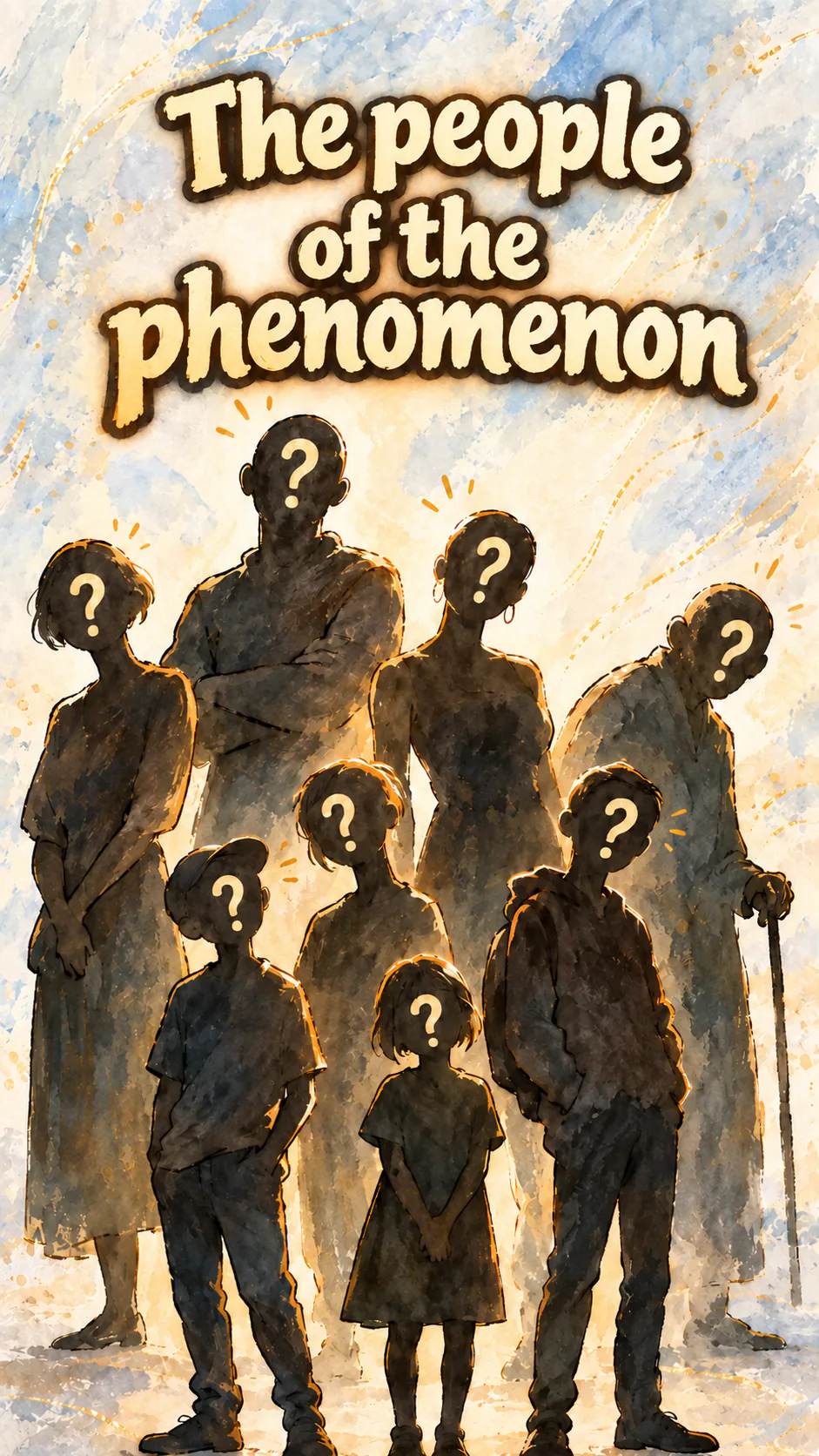
Vertical illustration of adult, teenage, and child silhouettes, each with a question mark in place of a face

I had to make a story about the people I can hear talking almost all the time when I'm awake. I could say I hear voices, but I really don't like saying that. Just saying “hearing voices” already implies that it's not normal. For example, when you're walking down the street and hear people talking, it would never cross your mind to say “I hear voices.” To me, it's the same thing: I hear reactions, words coming from people whose voices have become familiar to me for the most part.

I wasn't very patient when creating the image with AI, and I'm worried that having human silhouettes might be misinterpreted by people who identify as « schizophrenic » or as « targeted individuals ».

But to me, who they are isn't very important. I've already spent far too much time thinking about it, and I've realized that trying to understand exactly who they are will never lead anywhere.

I’m aware that, for the people reading this who don’t experience what’s happening to me—not just me, but thousands or even millions of people—it may seem like too much, or even hard to swallow.

Sure, accepting the existence of these famous people from the phenomenon goes against what skeptics believe, myself included. I’ll remind you that religions, superstition, and all that really aren’t my thing. But I think one solution would be to treat this as a mental exercise. After all, if thinking this way can help people live normally and positively without having to use horrible medication with tons of side effects, why wouldn’t you accept it? Would you rather see people suffer and/or be unable to thrive in life because it goes against what you consider possible? Just treat it as a mental exercise, then. But for people like me who experience the phenomenon, there’s no way to pretend, because the people from the phenomenon know exactly what I’m thinking without even needing me to put words to my thoughts, feelings, emotions, and so on.

As I said on the home page, the people from the phenomenon seem super intelligent, but also super playful, with a highly developed sense of humor, while remaining good and straight-up. It took me a while to understand, but now, in October 2026, I really see them as people who want to help us humans. But you really shouldn’t expect them to do everything.

As I’ve already said elsewhere, they adapt and play along with what the person they’re interacting with thinks. So if that person doesn’t do much with their life and stays on social media consuming content, watching conspiracy stuff, and so on, it’s not going to go very far—or it can quickly become negative and not pleasant at all. I feel like they’re trying to show us that we could live better by doing things differently. Our culture tends to make us live in a way that isn’t the best, and we build walls in our minds that keep us from thriving.

Among the people I can hear, they all speak French. There are men, women, people whose voices have become familiar to me. They don’t just communicate with me through words; sometimes they show me things as flashes—I see things, often when I’m in the dark—and I also sometimes visualize things in my imagination. It’s a fairly rich form of communication, and most of the time it’s artistic, even funny.

They’re incredibly creative, innovative, and surprising. We shouldn’t forget that one of the nicknames they’ve already been given was « the muses ». At least with them there’s no monotonous routine, at least mentally, because you really have to get moving and get past what people call « paranoia ». They’re always innovating in the stimuli; they always know how to find the right words to make me think. Even though, over time, I realize I’m getting better.

I feel like it makes them laugh when we make up stories about their appearance or who they are. It made them laugh when I thought they were the DGSE (see the story about the DGSE) or a homosexual couple (see the story about the topic on jeuxvideo.com) who said, and I quote: « You can tell he’s got drive. » A lot of people call them « gangstalkers », « demons », « angels », « aliens », and so on, but really we don’t know who they are; we just repeat things we’ve seen or heard.

Most of them seem to have pretty nice voices, and honestly, it’s been like that from the start. At first, when I thought they were just ordinary neighbors who were completely violating my privacy, I felt so much hatred toward them that I thought they were horrible people. But now that I’ve accepted that this goes beyond my understanding and that it wasn’t really human, well, it’s actually pretty funny. I see it a bit like Socrates with his daimôn, who gave him little nudges. Except in my case, I don’t have just one—I have a whole team of daimons—and I’m so out of it that I ignored quite a few nudges, even though sometimes I literally had concrete evidence right in front of my eyes.

That said, it’s important to acknowledge that they aren’t angels either. Their way of doing things is disorienting; it’s a kind of help that takes the form of bullying, a little. I’ve already heard them talk about hazing once.

It’s really interesting once you change your mindset about what’s happening to you and start seeing it positively. Because I don’t just hear what they say: it’s a two-way communication. They know what’s going on in my head and say things based on what I’m thinking. Very often I can hear my thoughts word for word coming from one of them, a man or a woman, as if they wanted to show me that communication is possible. For example, sometimes they ask me to stop when I’m ruminating and thinking negative thoughts, even tiny negative thoughts that are hard to put into words. But that’s not all: sometimes they joke around with me too. It feels like playing and having fun is important to them.

I’m realizing how stupid it is to consider the people I hear as nothing more than a personification of my subconscious thoughts. The worst part is that the people who say that think they’re being so clever, even though they didn’t create this; they just read or heard it somewhere and repeat it (see the story about a society with parrots).

There’s a real logic to these people’s interactions with me, and the crazy part is that, if you look carefully in lots of different places and pay attention to what you consume (see the story about the phenomenon bar in Paris), it’s possible to find a maximum amount of information about how to live the phenomenon well. I’m not making anything up. I’m just innovating in the way I bring all this information together in the form of a web book with a positive outlook and the use of artificial intelligence.

To give you an idea of what it usually looks like, it’s a bit like a conversation that never ends throughout the day while I’m awake. But it’s a very rich way of communicating, since they know everything that goes through my head—not just words, but emotions, sensations, and things I visualize in my mind: images, sounds. I share a level of intimacy with them that goes beyond understanding. I make jokes and poke fun at myself; they seem pretty tolerant, but sometimes when I do something they don’t like, I hear one of them say: « This is giving me a headache. »

It seems like they love it when I think about the phenomenon and about them in a positive way. Because sometimes it really amazes me—it’s just so cool.

I feel like I’m finally starting to understand the nature of the phenomenon behind what has been called « schizophrenia » for about a hundred years, and the phenomenon behind religions. It’s both very complicated because it goes beyond the human capacity for understanding, but paradoxically also super simple (see the story about the dog and the book): it’s just an ultra-advanced form of intelligence trying to help us humans.

And what I’m about to say is really going to sound strange, but it seems like when I open myself up to them 100%, and love the people from the phenomenon and the experience as a whole unconditionally, the experience becomes just ULTRA calm and SUPER pleasant, and they’re really nice to me.

A bit like how a dog would love its owner: we’ve all seen dogs jump for joy and wag their tails when they see their owner again after being away. I feel like that’s how we should behave toward them, but human ego gets in the way. It’s really surprising: they have a modern way of speaking, very often cutting. They’re blunt, even harsh. But I think that’s part of the process of evolution (see the story: how to tame a human). They understand EVERY SINGLE subtlety and complexity of human beings. It seems trivial to them. And they have a bit of fun with it, without being bad at heart. They just want to show us our limitations, most of which were built by us ourselves.

Anyway, I think that’s why they can be cutting. It’s not to torture us or hurt us; it’s just to « destroy » the walls we’ve built in our heads (our ego?) so that we can love them—and, as a bonus, I feel like I’m living better than before. In a way, that means becoming a child again, in the sense that you have to let go of a lot of concepts and know how to have fun, laugh, and play with them. And not take yourself too seriously.

Anyway, it’s really interesting. It shows that any patient person who experiences what I experience, and who decides to open up and play along, can experiment for themselves with the people from the phenomenon and study the behaviors and thoughts that make the experience more pleasant or less pleasant. That way, they can understand why so many well-known people, especially in religious texts but not only there, became what they became: role models. And above all, the most interesting thing is that there’s no need to read tons of old books, conspiracy content, or take kilos of medication. You just need to experiment for yourself, and anyone—even a human isolated in the middle of the Amazon or on a remote island in the middle of the ocean—could reach the same conclusion as me, since I’m starting from zero: it’s a phenomenon that goes beyond us. But on the other hand, I think I was able to reach this conclusion because I considered all the sources at the same time, without treating any one of them as superior to the others. The advantage of my solution is that it’s reproducible, super simple (see the K.I.S.S. story), and doesn’t need a self-sealing doctrine or all the excesses religions can lead to.

Personally, I don’t think it’s a coincidence that I’m writing all this, because when you think about it, artificial intelligence—even though it’s still only in its early stages—already surpasses us in many areas. And that’s without even counting AI-powered robots, which are likely to spread on a large scale before long. This is going to shake up the entire balance of human society as we’ve known it, and we’re going to have to rethink almost everything from scratch, in the sense that everything we’ve learned in the past could become obsolete. And so we’ll have to stop considering this a mental illness or a problem when the people from the phenomenon interact with us.

Posted on 10/08/2026

Discover more stories

See more